


Thank you for Subscribing to Electrical Business Review Weekly Brief


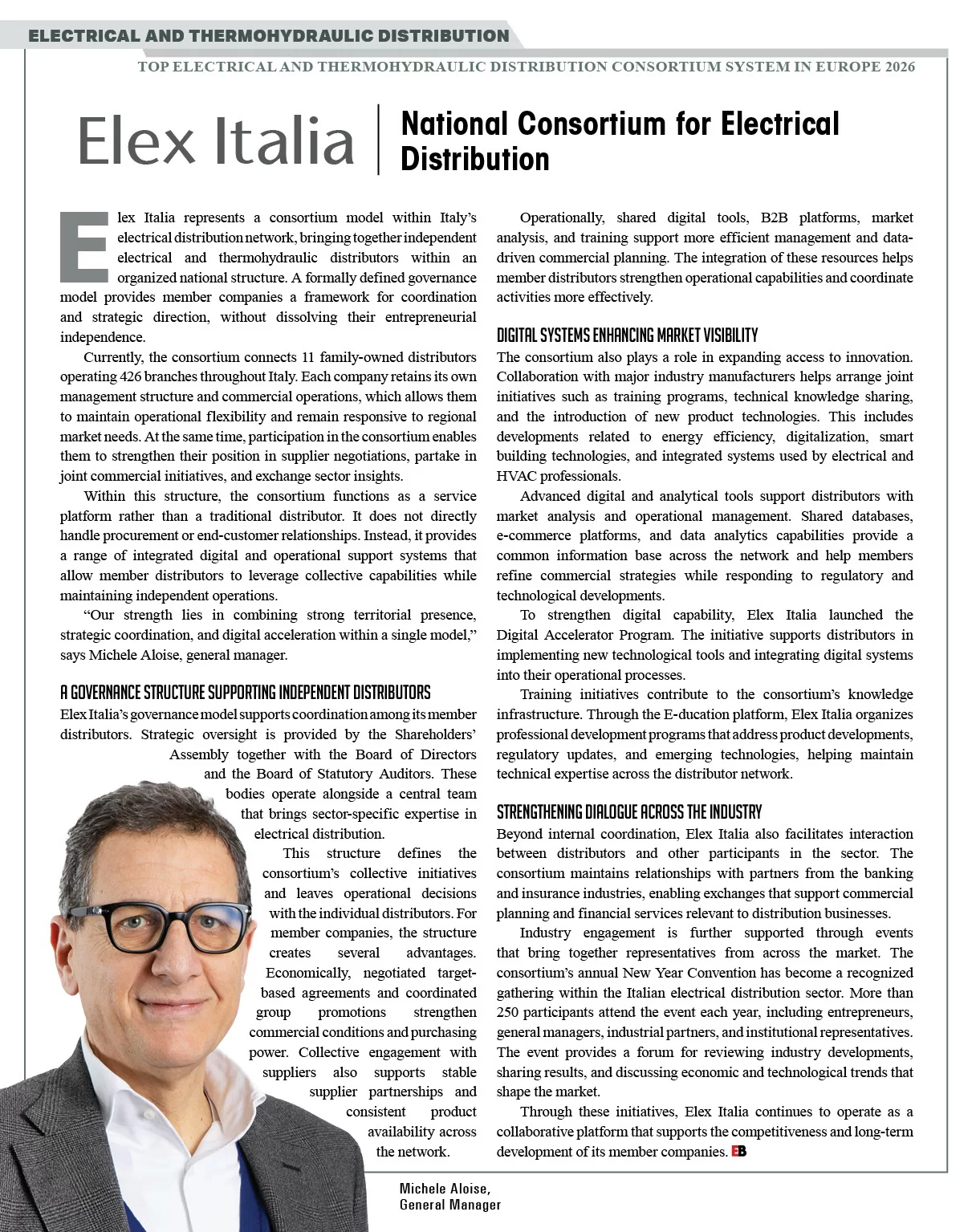
 Michele Aloise, General Manager
Elex Italia represents a consortium model within Italy’s electrical distribution network, bringing together independent electrical and thermohydraulic distributors within an organized national structure. A formally defined governance model provides member companies a framework for coordination and strategic direction, without dissolving their entrepreneurial independence.
Currently, the consortium connects 11 family-owned distributors operating 426 branches throughout Italy. Each company retains its own management structure and commercial operations, which allows them to maintain operational flexibility and remain responsive to regional market needs. At the same time, participation in the consortium enables them to strengthen their position in supplier negotiations, partake in joint commercial initiatives, and exchange sector insights.
Within this structure, the consortium functions as a service platform rather than a traditional distributor. It does not directly handle procurement or end-customer relationships. Instead, it provides a range of integrated digital and operational support systems that allow member distributors to leverage collective capabilities while maintaining independent operations.
“Our strength lies in combining strong territorial presence, strategic coordination, and digital acceleration within a single model,” says Michele Aloise, general manager.
A Governance Structure Supporting Independent Distributors
How does Elex Italia’s governance structure balance coordination with operational independence among members?
Elex Italia’s governance model supports coordination among its member distributors. Strategic oversight is provided by the Shareholders’ Assembly together with the Board of Directors and the Board of Statutory Auditors. These bodies operate alongside a central team that brings sector-specific expertise in electrical distribution.
This structure defines the consortium’s collective initiatives and leaves operational decisions with the individual distributors. For member companies, the structure creates several advantages. Economically, negotiated target-based agreements and coordinated group promotions strengthen commercial conditions and purchasing power. Collective engagement with suppliers also supports stable supplier partnerships and consistent product availability across the network.
-
Our strength lies in combining strong territorial presence, strategic coordination, and digital acceleration within a single model.
Operationally, shared digital tools, B2B platforms, market analysis, and training support more efficient management and data-driven commercial planning. The integration of these resources helps member distributors strengthen operational capabilities and coordinate activities more effectively.
Digital Systems Enhancing Market Visibility
Why are digital tools and shared data systems important for distributor network performance and strategy?
The consortium also plays a role in expanding access to innovation. Collaboration with major industry manufacturers helps arrange joint initiatives such as training programs, technical knowledge sharing, and the introduction of new product technologies. This includes developments related to energy efficiency, digitalization, smart building technologies, and integrated systems used by electrical and HVAC professionals.
Advanced digital and analytical tools support distributors with market analysis and operational management. Shared databases, e-commerce platforms, and data analytics capabilities provide a common information base across the network and help members refine commercial strategies while responding to regulatory and technological developments.
To strengthen digital capability, Elex Italia launched the Digital Accelerator Program. The initiative supports distributors in implementing new technological tools and integrating digital systems into their operational processes.
Training initiatives contribute to the consortium’s knowledge infrastructure. Through the E-ducation platform, Elex Italia organizes professional development programs that address product developments, regulatory updates, and emerging technologies, helping maintain technical expertise across the distributor network.
Strengthening Dialogue Across the Industry
In what way does industry engagement support collaboration and knowledge exchange within distribution ecosystems?
Beyond internal coordination, Elex Italia also facilitates interaction between distributors and other participants in the sector. The consortium maintains relationships with partners from the banking and insurance industries, enabling exchanges that support commercial planning and financial services relevant to distribution businesses.
Industry engagement is further supported through events that bring together representatives from across the market. The consortium’s annual New Year Convention has become a recognized gathering within the Italian electrical distribution sector. More than 250 participants attend the event each year, including entrepreneurs, general managers, industrial partners, and institutional representatives. The event provides a forum for reviewing industry developments, sharing results, and discussing economic and technological trends that shape the market.
Through these initiatives, Elex Italia continues to operate as a collaborative platform that supports the competitiveness and long-term development of its member companies.
Strategic Consortium Models for Electrical and Thermohydraulic Distribution
Electrical and thermohydraulic distribution across fragmented regional markets presents a structural challenge for executives responsible for sourcing reliable supply networks. Contractors, installers and project developers expect consistent product availability, competitive pricing and access to evolving technologies. Traditional distribution structures often struggle to balance local responsiveness with national scale. Fragmented purchasing power weakens supplier negotiations while centralized corporate networks can dilute local relationships that remain critical in technical trade markets.
Decision-makers evaluating modern distribution consortium systems therefore tend to examine how effectively a network reconciles scale with regional expertise. National reach alone offers limited value if local branches cannot respond quickly to contractors’ project timelines. Local autonomy alone also carries limitations when distributors lack the negotiating strength to secure stable supplier agreements or maintain broad product portfolios. A viable system typically demonstrates coordinated procurement frameworks, structured governance that aligns participating companies and shared digital infrastructure that strengthens collective intelligence across the network.
Negotiation power within supplier relationships often serves as a defining signal of long-term reliability. Electrical and HVAC supply chains increasingly depend on predictable pricing structures and sustained partnerships with manufacturers. Distribution systems that consolidate demand across multiple companies tend to secure structured commercial agreements and collaborative partnerships rather than purely transactional purchasing relationships. This dynamic improves price stability, strengthens product availability and creates a clearer path for manufacturers to introduce emerging technologies into regional markets.
Technology infrastructure has also become a decisive factor in modern consortium systems. Electrical distribution has historically relied on localized knowledge and manual coordination among distributors. Digital platforms now allow networks to coordinate commercial strategies, analyze market demand and share technical data more effectively across independent businesses. Data visibility across branches enables more informed product planning, while shared e-commerce platforms and digital analytics tools support faster response to evolving contractor needs. Systems capable of translating collective data into practical decision allow member distributors to remain competitive even as technical product ranges expand.
Another dimension influencing executive evaluation is the ability of a consortium structure to strengthen professional expertise across its network. Electrical and thermohydraulic markets require constant technical adaptation as regulations evolve and product systems become more integrated. Training programs, shared technical resources and industry partnerships often determine whether distributors can support installers working with complex building systems. A network that combines knowledge exchange, structured guidance and access to manufacturers’ innovation pipelines provides distributors with a stronger foundation for long-term competitiveness.
Governance architecture plays an equally important role in sustaining coordination among independent businesses. Distribution groups built on entrepreneurial member companies require transparent decision frameworks that align collective strategy while preserving local decision authority. Clear institutional structures, defined roles and coordinated planning mechanisms ensure that members benefit from collective scale without losing the responsiveness that defines successful regional distributors.
Elex Italia illustrates how this consortium model can operate at national scale while maintaining strong regional roots. The network brings together eleven member companies and more than four hundred distribution branches across Italy, forming a coordinated structure that combines local entrepreneurship with centralized strategic support.
Its role centers on enabling collaboration among distributors and suppliers through structured agreements, digital tools and shared market analysis rather than directly managing procurement. Group-level commercial frameworks improve negotiating leverage while digital platforms, data analytics and professional training strengthen decision-making capabilities across the network. Governance anchored in formal boards and shareholder coordination provides strategic alignment without removing managerial autonomy from member companies. This structure allows the consortium to support distributor competitiveness, facilitate access to advanced electrical and HVAC technologies and maintain the agility required in regional technical markets, positioning Elex Italia as a compelling choice.
...Read more
